

Your child has no toothache, eats comfortably, and has not mentioned a dental problem. When the dentist recommends X-rays, it is reasonable to ask why they are needed.
Pain is one piece of information, but it does not tell the whole story. Some concerns involve areas between teeth, developing permanent teeth, or a condition the dentist is already monitoring. An image may help answer a question that the examination alone cannot resolve.
The useful question is: What would this image help us understand about my child’s care? At Little Smiles Pediatric Dentistry, we want parents to feel comfortable discussing the reason for a recommendation before the next step.
Start With the Question the Dentist Needs to Answer
Dental X-rays complement a clinical examination. They should provide information relevant to diagnosis, treatment planning, or monitoring, rather than be taken simply because your child has reached a birthday or arrived for a checkup.
Ask the dentist to connect the recommendation to your child’s findings. That explanation may involve a tooth surface that cannot be examined directly, an eruption concern, or follow-up of an earlier problem.
Little Smiles Pediatric Dentistry provides dental X-ray services as part of its pediatric care. The reason for imaging and the views needed depend on the clinical question.
What Might Prompt a Recommendation Without Pain?
The following examples illustrate possible reasoning. They are not automatic imaging rules or descriptions of particular practice patients.
Back Teeth Touch Closely and Cavity Risk Needs Assessment
Imagine a child with a history of cavities whose back teeth touch closely together. The child feels fine, but the dentist cannot fully inspect the surfaces where those teeth meet.
Bitewing images may help assess those areas for decay. The decision also considers the examination, risk factors, and previous images. Teeth touching each other does not, by itself, mean new X-rays are required at every appointment.
A Permanent Tooth Is Not Emerging as Expected
A child may have no pain while a tooth’s eruption pattern raises a question. After examining the area and reviewing development, the dentist may want information about the position or presence of a permanent tooth.
Imaging can help determine whether observation or further evaluation is appropriate. An eruption concern may require a different view from the bitewings used to assess decay between back teeth. Developmental variation alone is not a reason to assume something is wrong.
A Previously Injured or Treated Tooth Needs Follow-Up
An earlier injury, deep cavity, or dental treatment may create a reason to reassess a tooth even when current symptoms are absent.
The dentist considers the earlier findings, what has changed, and whether an image would help evaluate the tooth or surrounding structures. Follow-up is based on the situation rather than on whether the child reports pain that day.
What Does the Dentist Consider Before Taking Images?
An imaging recommendation begins with your child’s history and examination. During dental cleanings and examinations, the team can review previous cavities, injuries, restorations, dental development, and areas that need attention.
Cavity risk also matters. Past decay, home-care challenges, frequent sugary snacks, and fluoride exposure can help inform the assessment. These factors guide judgment; they do not make every child with a particular habit a candidate for the same images.
Your child’s ability to tolerate the procedure belongs in the discussion, too. The dentist needs to consider whether useful diagnostic images can be obtained and what adjustments might help.
A recommendation should connect these findings to an expected benefit for care. The absence of symptoms does not automatically rule imaging out, and age alone does not automatically rule it in.
Could Previous X-Rays Answer the Question?
Tell the team when and where your child last had dental imaging. If another office holds the images, ask about arranging a records transfer before the visit when possible.
The dentist can review whether those images show the relevant area clearly and provide enough information for the current concern. Older images may be useful, but a new finding or a different diagnostic question can still justify additional views.
Sharing records helps the team assess the need for new imaging. It does not guarantee that another image can be avoided, and you do not need to decide which records are clinically sufficient yourself.
How Could the Results Change the Plan?
Before imaging, ask what decisions the result might inform. Afterward, ask the dentist to explain the images alongside the examination findings.
Possible next steps include:
- Continue current care: No finding requires an immediate change, and the dentist recommends ongoing visits and home care.
- Adjust prevention or monitoring: A finding may affect your child’s preventive dental care or need reassessment at an appropriate time.
- Discuss treatment or further evaluation: The images and examination together may support a recommendation that the dentist explains with its alternatives.
An image does not automatically lead to a filling or other procedure. Interpretation depends on the whole clinical picture, and X-rays cannot reveal every dental problem.
If monitoring is recommended, ask what change the dentist is watching for and how follow-up will be arranged. If treatment is proposed, ask how the image supports that recommendation and what alternatives may fit. This keeps the conversation connected to your child’s findings rather than to a procedure alone.
Questions to Ask Before You Decide
You do not need technical knowledge to take part in the conversation. Consider asking:
- What are you trying to evaluate with this image?
- Which examination findings or risk factors prompted the recommendation?
- Could previous images provide the information you need?
- How might the result change care or monitoring?
- What would remain uncertain without it?
- What should we consider if my child cannot manage the procedure today?
Ask for clarification if the explanation feels too technical. Understanding the purpose of imaging is part of making an informed decision, especially when your child appears well.
You can also ask which area will be pictured and why those particular views are being proposed. The phrase dental X-rays can describe different images with different purposes. An explanation of the planned views can make the recommendation easier to understand than a general statement that X-rays check everything. The dentist should be able to relate the proposed images to the question being investigated.
What if You Are Considering Postponement?
Explain your concern rather than using the absence of pain as the deciding factor. Ask whether the recommendation is time-sensitive, what waiting could mean, and whether previous images are adequate.
If an indicated diagnostic image cannot be obtained, the dentist should explain the limits this places on assessment and planning. Whether particular care can proceed without it depends on the child’s needs, urgency, and the available options.
A visual examination or photograph does not always provide the same information. Equally, a discussion about uncertainty should help you understand the decision rather than make you feel that every comfortable child must have imaging.
The next step should be based on your child’s situation. Do not assume that declining an image has the same consequences for every patient or every proposed treatment.
Helping Your Child Understand the Process
Tell the team about sensory preferences, previous difficulties, or concerns about positioning. Little Smiles uses Tell, Show, Do to explain care in child-friendly terms, demonstrate what will happen, and then proceed as appropriate.
You can help by describing the visit simply and avoiding promises about exactly how it will feel. Ask the team how best to prepare your child. Comfort measures and explanations should fit the child, without guaranteeing that every image can be obtained at that visit.
Frequently Asked Questions
Does Recommending X-Rays Mean the Dentist Has Found a Cavity?
No. Imaging may help investigate a concern, assess an area that is difficult to examine, or monitor development or previous care. Ask what prompted the recommendation rather than assuming a diagnosis has already been made.
Can I Ask to See the Images?
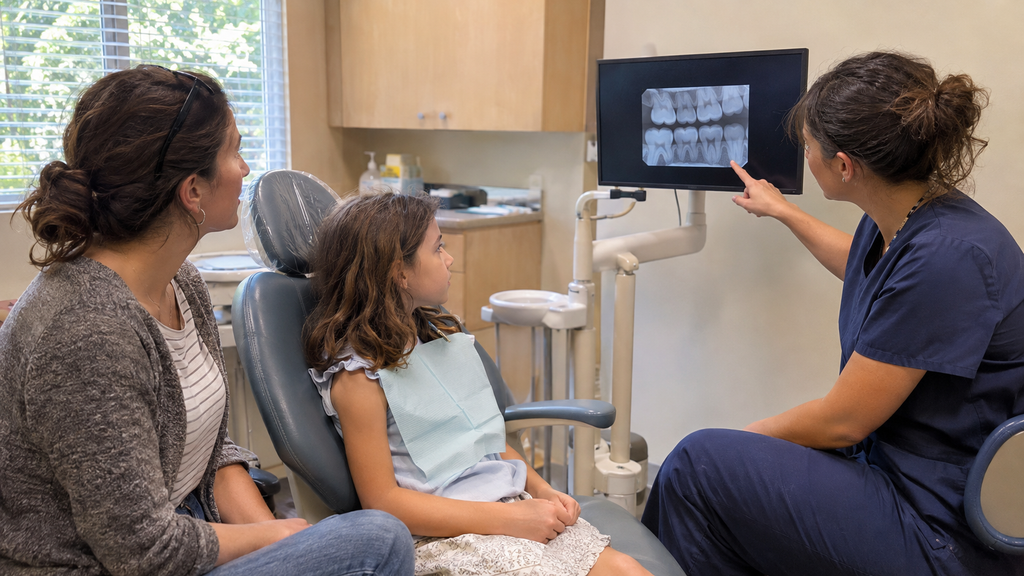
Yes. Ask the dentist to show you the relevant area and explain how it relates to the examination. You can also ask about obtaining copies for your child’s records or sharing them with another dental provider.
If Nothing Needs Treatment, Was the Image Unnecessary?
A result that does not lead to treatment can still provide useful information. Whether imaging was appropriate depends on the clinical question and expected value when it was recommended, not solely on whether a problem was found afterward.
Discuss Your Child’s Imaging Recommendation
You deserve an explanation that connects a recommendation to your child’s care. Ask what the image could show, how it might affect the plan, and whether existing records can help.
Schedule your child’s next dental examination with Little Smiles Pediatric Dentistry to discuss your questions. Our offices in Dardenne Prairie, Hazelwood, and Washington, Missouri, support families with individualized pediatric care and clear communication.